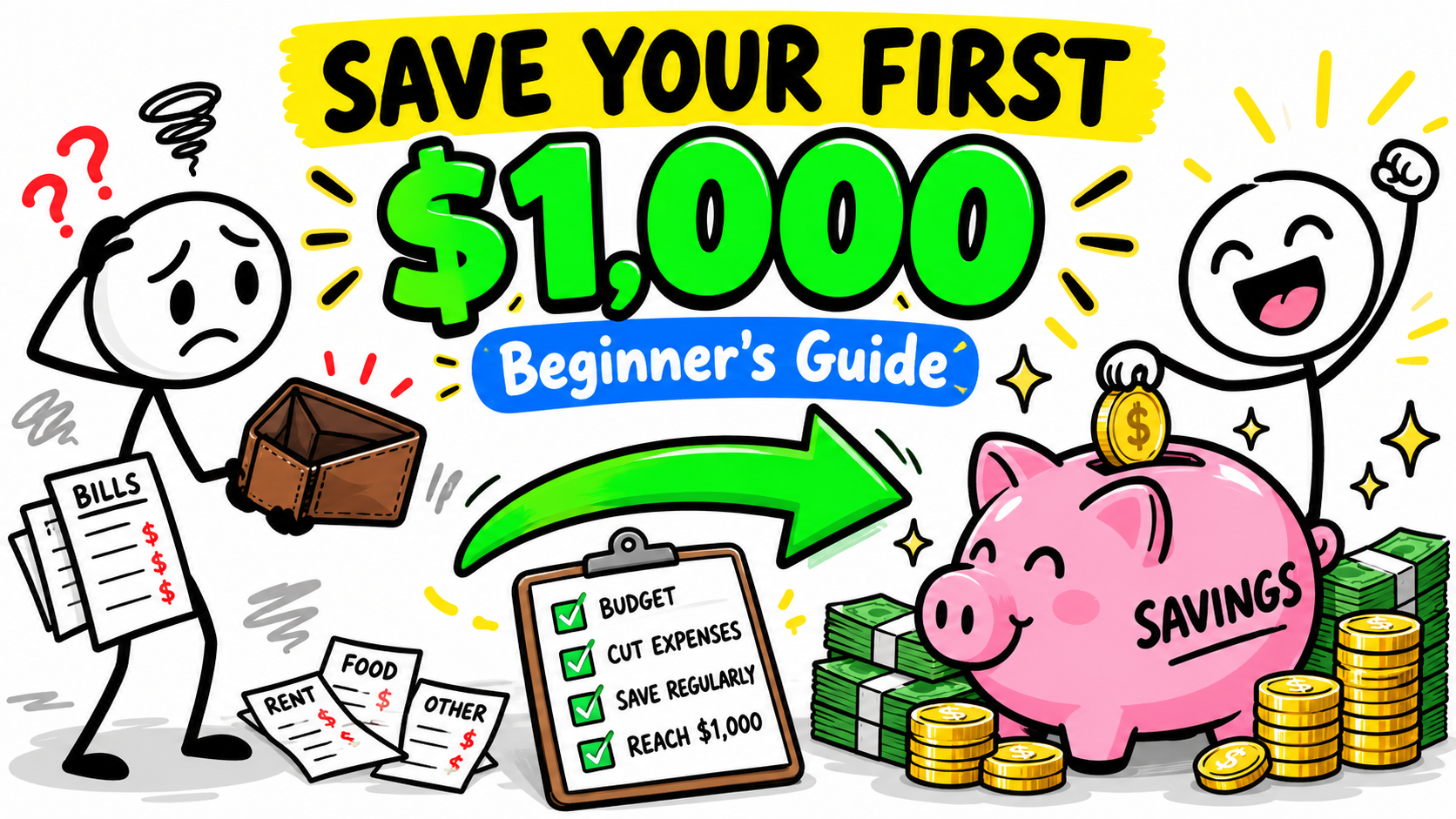
Saving your first $1,000 may seem difficult, especially if you have a low income or many monthly expenses. You might think you need a high-paying job or a lot of extra money to start saving.
But the truth is, you can start with a small amount.
Saving money is not only about how much you earn. It is also about how you manage your money, control your spending, and build good financial habits.
Your first $1,000 can help you feel more financially secure. It can also protect you from unexpected expenses, such as medical bills, car repairs, or losing your job.
The good news is that you do not have to save $1,000 all at once.
In this beginner’s guide, you will learn 10 simple and realistic ways to save your first $1,000, even if you are starting with very little money.
1. Set a Clear Savings Goal
The first step to saving $1,000 is setting a clear goal.
Instead of simply saying, “I want to save more money,” make your goal specific.
For example:
“I want to save $1,000 in the next 12 months.”
Having a clear target helps you understand how much money you need to save regularly.
If you want to save $1,000 in one year, you would need to save approximately:
- $83.34 every month
- $19.24 every week
- $2.74 every day
These amounts may seem more manageable than thinking about saving $1,000 at once.
However, you do not have to follow a 12-month plan.
If your income is limited, you can choose a longer timeline.
The most important thing is to create a savings goal that fits your financial situation.
2. Start With Whatever You Can Afford
One common mistake beginners make is waiting until they have more money before they start saving.
They may think saving $1 or $5 is not worth it.
However, small savings can grow into meaningful amounts over time.
For example:
- Saving $10 per month gives you $120 in one year.
- Saving $25 per month gives you $300 in one year.
- Saving $50 per month gives you $600 in one year.
- Saving $100 per month gives you $1,200 in one year.
You do not need to save the same amount as someone else.
If you can only afford to save $5 this week, that is still progress.
You can increase your savings later when your income improves or your expenses decrease.
Remember, the goal is to develop a saving habit that you can maintain.
3. Create a Simple Monthly Budget
A monthly budget is one of the most useful tools for managing your money.
It helps you understand how much money you earn and where your money goes.
You do not need expensive software to create a budget. A notebook, spreadsheet, or free budgeting app can work.
Start by writing down your monthly income.
Next, list your essential expenses, including:
- Rent or housing payments
- Food and groceries
- Electricity and water
- Transportation
- Phone and internet
- Minimum debt payments
- Other necessary expenses
After that, review how much money you spend on non-essential items.
For example, imagine you earn $600 per month.
Your budget might look like this:
| Category | Monthly Amount |
|---|---|
| Rent | $220 |
| Food | $150 |
| Transportation | $50 |
| Utilities and phone | $60 |
| Debt payments | $40 |
| Personal expenses | $30 |
| Savings | $50 |
| Total | $600 |
In this example, you could save $50 per month if your expenses stay within the budget.
At that rate, you would reach $1,000 in 20 months, without counting any interest.
Your budget may look different depending on your income, location, and family needs.
The purpose of budgeting is not to make your life difficult. It is to help you spend your money more carefully.
4. Reduce Small Daily Expenses
Small purchases may not seem expensive, but they can add up over time.
For example, buying a $3 snack or drink every day costs approximately $90 over 30 days.
That is $1,080 over 12 months.
Of course, this does not mean you must stop buying everything you enjoy.
Instead, look for expenses you can reduce without affecting your basic needs.
Here are a few ideas:
- Prepare snacks at home.
- Bring your own water when going outside.
- Cook more meals instead of ordering food.
- Avoid buying things you do not need.
- Compare prices before making purchases.
- Cancel subscriptions you rarely use.
For example, if you reduce unnecessary spending by $20 per month, you could save an additional $240 in one year.
Small changes in your daily routine can help you reach your $1,000 goal faster.
5. Keep Your Savings Separate
One simple way to protect your savings is to keep them separate from your everyday spending money.
When all your money is in one account or wallet, it can be easy to spend the money you planned to save.
Consider opening a separate savings account at a reputable bank or financial institution.
Look for an account that has:
- Low or no monthly fees
- No high minimum balance requirement
- Easy access when you need your money
- Clear terms and conditions
- Appropriate deposit protection where available
For example, if you receive $500 from your job, you could transfer $20 into your savings account, provided your essential expenses are covered.
Try to treat that money as part of your emergency savings instead of money for regular shopping.
Keeping your savings separate can make it easier to see your progress.
6. Save Money Every Payday
A useful financial habit is to save a small amount whenever you receive your income.
This is sometimes called “paying yourself first.”
For example, if you receive your salary twice a month, you could save $10 from each payment.
That would give you $20 in savings every month.
If your income allows you to save more, you can increase the amount.
You can also set up an automatic transfer from your main bank account to your savings account.
However, make sure you leave enough money to pay for rent, food, utilities, and other essential needs.
If you have irregular income, such as freelance earnings or daily wages, you can save a small percentage whenever you get paid.
Even saving 2% or 5% of your income can help you build a regular habit if your budget allows it.
The important thing is to make saving part of your normal financial routine.
7. Try a Simple Money-Saving Challenge
Saving money can become easier when you turn it into a personal challenge.
A savings challenge gives you a clear plan to follow.
Here are three simple challenges for beginners.
The $5 Weekly Challenge
Save $5 every week.
After 52 weeks, you will have saved $260.
This challenge is a good starting point if you have limited money.
The $20 Weekly Challenge
Save $20 every week.
After 50 weeks, you will have saved $1,000.
This challenge may work for people who have some extra money after paying their monthly expenses.
The $100 Monthly Challenge
Save $100 every month.
After 10 months, you will reach your $1,000 goal.
This plan may be suitable for people with higher disposable income or fewer monthly expenses.
You can also create your own challenge based on how much you can realistically afford.
If you miss a week or a month, you do not need to give up. Simply continue saving when you can.
8. Find Ways to Earn Extra Money
Sometimes, saving money through spending cuts is not enough.
If your income barely covers your living expenses, earning extra money may help you reach your goal.
You do not need to start a large business.
There are many simple ways to earn additional income, depending on your skills, location, and free time.
Some examples include:
- Selling items you no longer use
- Offering tutoring services
- Doing freelance writing or graphic design
- Selling homemade food
- Helping with cleaning or household tasks
- Providing online services
- Working part-time when your schedule allows
For example, imagine you earn an extra $50 each month and can save all of it.
After one year, you would have an additional $600 toward your savings goal.
If you already save $40 per month, combining that with the extra $50 could help you save $90 per month.
At that rate, you could reach $1,000 in about 12 months.
Be careful with online jobs or business opportunities that ask you to pay large upfront fees or promise easy money.
Focus on realistic ways to earn income without putting your existing savings at risk.
9. Avoid Using Your Savings for Unnecessary Purchases
Once you start saving money, it may become tempting to spend it.
For example, you may have saved $300 and see a new phone or other expensive item that you want to buy.
Before using your savings, ask yourself:
“Is this something I really need right now?”
Your first $1,000 should ideally serve as a financial safety net.
It can help you cover unexpected expenses, such as:
- Emergency medical costs
- Essential vehicle repairs
- Urgent home repairs
- Temporary loss of income
- Other necessary expenses
Try to keep your emergency savings for genuine needs.
However, if you need to use the money for a real emergency, that is exactly what it is there for.
You can rebuild your savings afterward.
10. Track Your Savings Progress
Tracking your progress can help you stay motivated.
You can use a notebook, spreadsheet, or simple savings tracker.
For example, if your goal is to save $1,000, divide it into smaller milestones:
| Savings Milestone | Progress |
|---|---|
| $100 | 10% |
| $250 | 25% |
| $500 | 50% |
| $750 | 75% |
| $1,000 | 100% |
Each milestone shows that you are moving closer to your goal.
Reaching $100 for the first time is an achievement.
Reaching $500 means you are halfway there.
You can review your savings at the end of each month to see what is working and what needs to change.
If you save less than expected, adjust your plan instead of giving up.
Financial progress does not have to be perfect.
How Long Does It Take to Save $1,000?
The time needed to save $1,000 depends on how much money you can set aside each month.
Here is a simple example:
| Monthly Savings | Time to Reach $1,000 |
|---|---|
| $10 | 100 months |
| $20 | 50 months |
| $25 | 40 months |
| $50 | 20 months |
| $75 | 14 months |
| $100 | 10 months |
| $150 | 7 months |
| $200 | 5 months |
Note: These estimates assume you start from $0, save the same amount every month, and earn no interest. The final month may require less than your usual savings amount.
As you can see, saving more money each month can help you reach your goal sooner.
However, there is no need to rush if doing so would make it difficult to pay your bills.
A realistic savings plan is usually easier to maintain than an aggressive one.
Common Mistakes to Avoid When Saving Your First $1,000
When starting your savings journey, there are several mistakes you should try to avoid.
1. Saving without a plan
Without a clear goal or budget, it can be difficult to make consistent progress.
2. Setting unrealistic goals
Trying to save too much may leave you without enough money for essential expenses.
3. Spending money just because it is on sale
A discounted product is not a good deal if you do not need it.
4. Using savings for everyday wants
Regularly withdrawing money for unnecessary purchases can slow your progress.
5. Ignoring high-interest debt
Expensive debt can grow quickly. Depending on your situation, paying down high-interest debt while keeping a small emergency fund may be a better approach.
6. Giving up too early
Saving takes time. Missing one savings target does not mean you have failed.
Avoiding these mistakes can help you build better financial habits.
Final Thoughts
Saving your first $1,000 is an important step toward better money management.
You do not need to be rich or have a high-paying job to begin.
Start by setting a clear goal, creating a simple budget, reducing unnecessary expenses, and saving small amounts whenever you can.
Remember that saving money is not a competition.
Some people may reach $1,000 in a few months, while others may need several years.
What matters most is creating a plan that works for your income and financial responsibilities.
Your first $1,000 starts with your first dollar.
Stay patient, make smart spending decisions, and celebrate your progress along the way.
Over time, these small financial habits can help you build savings and become more confident about your financial future.